
My reaction to the recent New York Times Magazine piece on testosterone
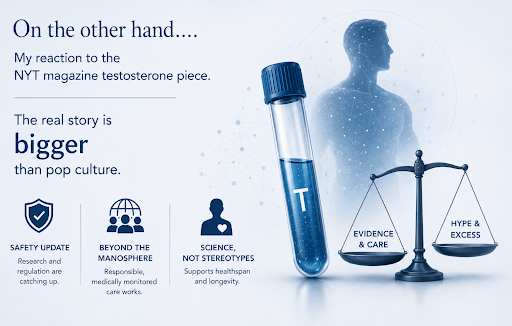
My reaction to the recent New York Times Magazine piece on testosterone, “The Testosterone Moment is Here. And Men May Never Look the Same” (May 12) is a classic case of “on the one hand, but on the other.” On the one hand, I don’t think I’ve ever read a piece in the mainstream media with as many glowing anecdotal accounts of testosterone replacement therapy (TRT) – improved body composition, libido, energy, mood, even “my wife likes me again.” (The author interviewed 14 men on TRT – did anyone have a less than great experience?). As a physician who’s been prescribing testosterone to my male patients with excellent results for several decades, I can’t help but feel gratified.
Then there’s the “on the other hand”. The author chose to shoehorn a story about the increasing medical acceptance of TRT into a pop culture piece on the rise of the right-wing-coded “manosphere” and its fetishization of big muscles (see Joe Rogan, Pete Hegseth, RFK Jr.). And I suppose one could make a connection – as the NYT does -- between the pop cultural embrace of muscular hypertrophy and increasing numbers of Americans flocking to on-line testosterone prescription mills, without adequate, or very minimal, medical oversight. But none of this has anything to do with what I, and my longevity medicine physician peers, have been doing, safely and successfully, for many years -- prescribing testosterone to our male patients in carefully monitored dosages and seeing positive results across a range of important physiological measures.Which, for the record, include enhanced muscle mass and strength. Muscle is a powerful endocrine organ helping to regulate metabolic health, and it provides a valuable bulwark against the frailty that so many seniors are vulnerable to.
Although somewhat obscured by those easy manosphere pot-shots, there is plenty of good news about TRT in the article. The traditional medical party line, faithfully reported by the mainstream media, was that hormone replacement had to be treated with the utmost caution because of research that suggested it might raise the risk of heart attacks and prostate cancer. The Times has caught up with the times, mostly dispelling those fears by referencing the large 2023 TRAVERSE trial that found that men on TRT suffered no greater incidence of either malady. (Longstanding fears about prostate cancer, as the article reports, were generated by a 1941 observational study that looked at a single man on the hormone who developed the cancer.) The one health concern it did raise, voiced by an urologist, is that supplemental testosterone can decrease male fertility. Left unsaid was that the solution is pretty straightforward – if you’re trying to conceive, go off the hormone!
The regulatory arena is also catching up with the research. The article notes that the FDA removed the “black box” health warning from supplemental testosterone this past February and it plans to broaden its criteria for prescription to include men who have “normal” low testosterone levels – no medical pathology need be detected – as well as for the treatment of low libido, certainly a common aging male complaint. (It should be noted that estrogen therapy for menopausal women has followed a similar trajectory, overblown safety fears giving way to somewhat broader acceptance.)
My main issue with the Times piece is not what it says, but what it leaves out. For starters, like most primary care physicians and even some endocrinologists, the article takes as gospel the conventional threshold for TRT prescription, a total testosterone level of lower than 300 nanograms per deciliter. But total testosterone is often a misleading metric in aging men. Free testosterone — the biologically active fraction — frequently declines much more dramatically due to rising sex hormone binding globulin (SHBG), changes in body composition, insulin resistance, inflammation, medications, and other age-related endocrine shifts. An overweight 79-year-old man may have a total testosterone level that appears “robust” on paper while his free testosterone is profoundly hypogonadal.
Beyond that confusion is mainstream medicine’s lockstep adherence to an old-fashioned binary logic. If you’re below a certain number, you have a pathology that may warrant treatment, above it, you’re fine. Unfortunately, that’s not the way the body works. Our physiological systems operate on a spectrum – no single point on that spectrum is definitive of anything. Medicine understands that when it comes to cardiovascular disease or metabolic health. No competent doctor would deny treatment to a patient because her systolic blood pressure hadn’t yet crossed into the 140s, or he was still “only” pre-diabetic. But, somehow with hormones, it’s all or nothing.
In my view, what underlies this simplistic attitude, and what the medical mainstream too often misses, is that testosterone, like estrogen, is not just a sex hormone. It is a human function hormone, one component of a highly interconnected biological network and a crucial contributor to overall healthspan.
One of the most underappreciated aspects of testosterone deficiency is its relationship to chronic inflammation and biological aging. Low testosterone levels are associated with elevated inflammatory cytokines, endothelial dysfunction, worsening insulin resistance, immune dysregulation and increased visceral adiposity. Visceral fat itself becomes an inflammatory endocrine organ, amplifying aromatase activity and depressing testosterone levels, accelerating the vicious cycle.
For all the loose talk about muscles and the manosphere, my clinical work, as well as my collaboration with glycan biology pioneer Gordon Lauc, suggests that one of the biggest health boosts provided by robust testosterone levels may be lifting levels of estrogen, crucial for immune health and keeping inflammation at bay. Yes, TRT has an androgenic or “masculinizing” effect but, just as importantly, it can reduce “inflammaging” which in turn protects mitochondrial function, immune competence, vascular integrity, and resilience across the lifespan.
I’d like to read about that the next time the media tackles testosterone.
A. Michael Lincoff M.D. et. al.Cardiovascular Safety of Testosterone-Replacement Therapy. N Engl J Med 2023;389:107-117
DOI: 10.1056/NEJMoa2215025


Comments